

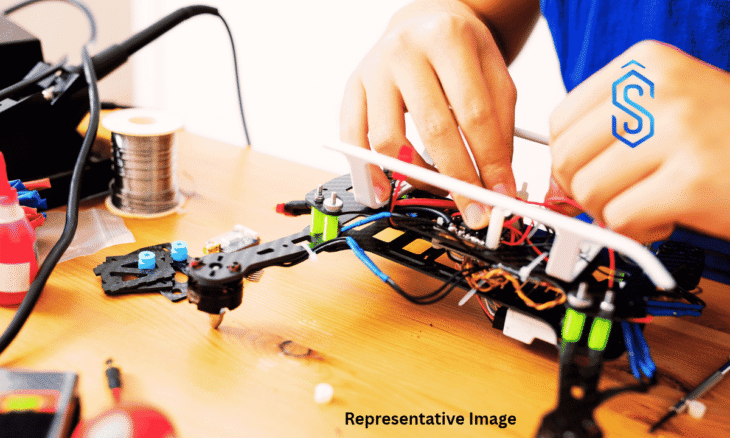
Bengaluru: India has expanded its domestic drone manufacturing capabilities, with more than 160 drone models receiving type certificates and over 200 manufacturers building defence drones.
However, the country’s growing drone industry faces a critical challenge: developing the components that go inside these machines.
From magnets and battery cells to chips and autopilots, several critical drone components are still imported.
China’s export controls on drone parts since September 2024 and on rare earth magnets since April 2025 have further exposed the risks of depending on overseas suppliers for essential technologies. According to DFI’s whitepaper, wider controls covering autopilots are scheduled to take effect on 18 November 2026.
The issue is becoming increasingly important as India looks to build a domestic drone industry that extends beyond assembling finished products.
Drone Federation India (DFI), which estimates that India’s drone industry could grow from ₹5,720 crore in 2025-26 to around ₹97,300 crore by 2030-31, has identified the component ecosystem as a critical area for intervention.
The component market alone is targeted at USD 3.08 billion.
The industry body’s latest whitepaper, Making the Swadeshi Switch, outlines 22 policy recommendations aimed at accelerating domestic drone components manufacturing, strengthening local supply chains and reducing import dependence.
Released at the Bharat Drone Stack Conference 2026 in Bengaluru, the recommendations focus on Indian content norms for defence and civilian drones, targeted support for component manufacturers, and domestic testing and certification infrastructure.
India’s Drone Manufacturing Growth Faces a Component Challenge
India’s drone manufacturing ecosystem has expanded considerably, but the availability of domestically manufactured components remains a key challenge.
As Smit Shah, President of Drone Federation India, pointed out, the country has made progress in developing drone models and expanding its manufacturing base.
However, the origin of the components determines how much of a drone’s value chain is genuinely domestic.
“India has done the first half of the job. More than 160 drone models now hold type certificates, and more than 200 manufacturers are building defence drones of various categories. But a drone is only as Indian as the parts inside it, and any single source for a flight-critical part is a risk, because supply can be cut overnight.”
This dependence is particularly relevant for flight-critical components, where a disruption in the supply of even one part could affect manufacturing operations.
The challenge extends across multiple layers of the manufacturing ecosystem, including magnets, cells, chips, autopilots and other specialised electronic systems.
China’s export controls on drone-related components and materials since September 2024 have brought this vulnerability into sharper focus. For India, building domestic capabilities in these areas is not just about increasing local manufacturing but also about securing access to critical technologies and materials.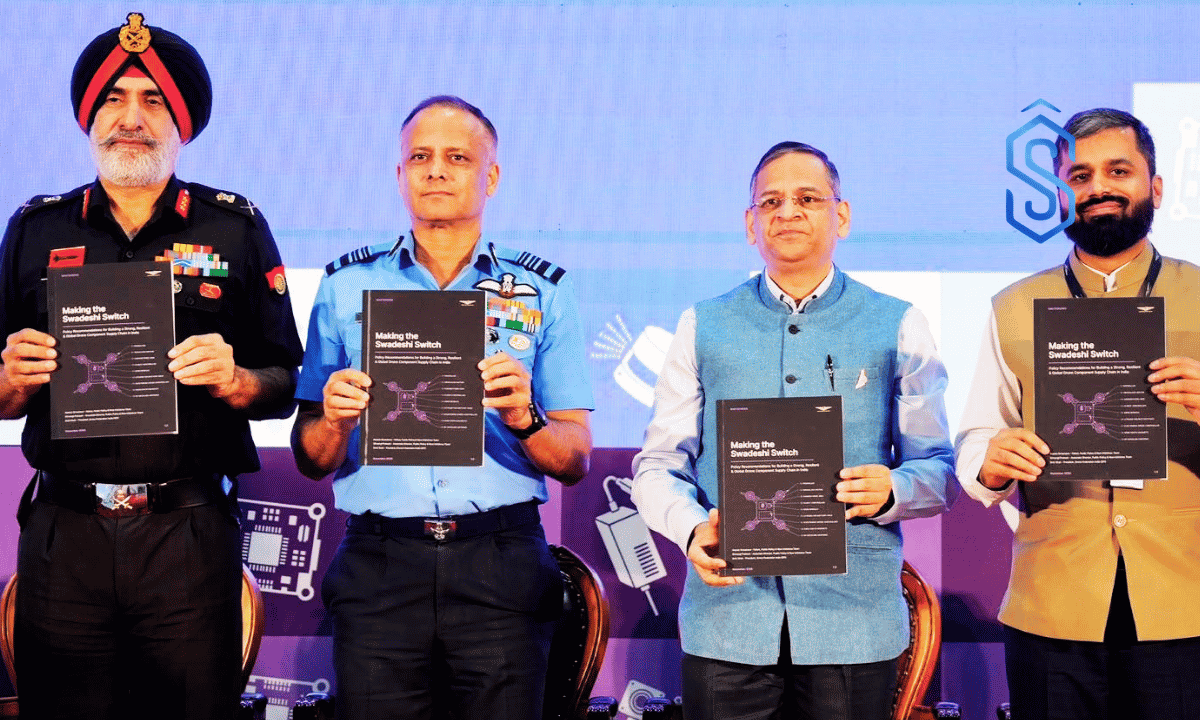
$3.08 Billion Drone Components Market: Where Is the Opportunity?
The projected growth of India’s drone industry presents a significant opportunity for domestic component manufacturers.
DFI estimates that the overall industry could expand from ₹5,720 crore in 2025-26 to approximately ₹97,300 crore by 2030-31. Within this growth trajectory, the drone components market is targeted at USD 3.08 billion.
However, capturing this opportunity will require capabilities across the component value chain rather than an exclusive focus on manufacturing finished drones.
The 22 recommendations in DFI’s Making the Swadeshi Switch whitepaper seek to address some of these gaps.
The proposals include:
- Introducing Indian content norms for defence and civilian drones.
- Providing targeted support to domestic component manufacturers.
- Establishing testing and certification capabilities for components within India.
DFI plans to take these recommendations to the relevant ministries and government agencies. Progress on the proposals will be reviewed at the next edition of the Bharat Drone Stack Conference in 2027.
Bharat Drone Stack Maps 243 Drone Parts and 52 Raw Materials
Identifying where India needs to build manufacturing capabilities is another important part of the domesticisation effort.
Through its Bharat Drone Stack initiative, launched in August 2025, DFI is attempting to map the country’s drone component supply chain and identify opportunities for domestic manufacturers.
The Bharat Drone Stack Platform, which initially identified approximately 100 suppliers, now lists 208 suppliers, including 83 startups.
Its component breakdown maps a drone across 11 categories, 62 subsystems, 243 individual parts and 52 raw materials.
This level of mapping provides a view of the different layers involved in drone manufacturing, from the raw materials required to produce individual components to the subsystems that eventually make up a complete drone.
For an industry seeking to reduce import dependence, identifying these requirements is an important step towards understanding where domestic manufacturers and startups can participate in the supply chain.
The inclusion of 83 startups among the 208 listed suppliers also highlights the role of emerging companies in developing India’s drone component ecosystem.
Defence Requirements Could Shape India’s Drone Components Industry
The push for domestic drone components is also closely linked to the changing requirements of India’s defence forces.
Modern military operations are creating requirements for drones and electronic systems that can meet specific operational and security standards. This makes component reliability, hardware integrity and electronic system security important considerations for manufacturers.
At the Bharat Drone Stack Conference 2026, discussions involving the Indian Army, Indian Air Force, CISF, BSF and SSB examined what modern conflict demands from India’s drone industry.
Another discussion involving DRDO and the Directorate General of Aeronautical Quality Assurance (DGAQA) focused on the proposed “Trusted Indian Component” mark.
The idea of a trusted component framework is particularly relevant as India looks to develop domestic suppliers for critical drone systems.
The conference also featured a session on import dependence and policy interventions, chaired by Maj Gen Roopesh Mehta, SM, VSM, Additional Director General, Capability Development, Indian Army.